
You can start charting the night sky tonight by recognizing that constellations are 88 officially mapped territories with fixed boundaries, not merely connect-the-dot shapes.
Begin with three landmarks: the Big Dipper, Orion’s Belt, and the Summer Triangle. Use the Big Dipper’s pointer stars to locate Polaris, your anchor for true north.
Grab a planisphere or binoculars, head outside, and you’ll soon transform scattered stars into familiar territory you’ll confidently explore.
What Constellations Really Are (Not Just Star Patterns)
When you look up at the night sky, those familiar star patterns might seem like simple connect-the-dot drawings, but constellations are actually something far more precise. You’re seeing 88 officially defined regions with exact IAU boundaries, not just pretty shapes. These boundaries use celestial coordinates, right ascension and declination, to map every star position with mathematical accuracy.
Don’t confuse constellations with asterisms; those informal patterns like the Big Dipper lack official status. The stars you connect appear close together, yet they’re scattered at wildly different distances. Your visibility from Northern Hemisphere skies reveals only a portion of these regions, changing with seasons and latitude. Understanding this distinction transforms how you navigate the heavens, replacing vague stargazing with genuine astronomical literacy. Additionally, home planetariums can enhance your stargazing experience and help you identify these constellations in detail.
The 88 Official Constellations (and Why the Sky Has Boundaries)
You’ll find exactly 88 official constellations when you scan the night sky, each one locked into precise boundaries that the International Astronomical Union established in 1928. These borders aren’t arbitrary lines drawn in the dark, they’re scientific coordinates of right ascension and declination that guarantee every single star belongs to one, and only one, constellation. When you learn this system, you’re not just memorizing patterns; you’re navigating a complete map that covers both hemispheres and ensures you’ll never wonder which constellation claims that bright star you’re staring at. Using a home planetarium can greatly enhance your ability to visualize and understand these constellations in a dynamic and engaging way.
Official Constellation Count
Ever wonder why stargazers can agree on exactly where one constellation ends and another begins? You can thank the IAU for that clarity. In 1928, they established the official count of 88 constellations, each with precise boundaries on the celestial sphere. This means every point in the sky belongs to exactly one constellation: no gaps, no overlaps.
Here’s what this system gives you:
- Complete sky coverage, every star has a designated home
- Scientific precision, coordinates replace guesswork
- Universal consistency, astronomers worldwide use identical maps
- Historical continuity, ancient patterns preserved within modern borders
You will find this framework surprisingly practical. When you locate Orion, you know precisely where Taurus begins. The boundaries transform stargazing from vague shapes into navigable territory, letting you explore with confidence rather than confusion. Additionally, modern tools like home planetarium projectors can elevate your stargazing experience even further by bringing the cosmos indoors.
Sky Boundary Purpose
Why do astronomers draw borders across the infinite sky? You’re looking at a system that turns chaos into order. The IAU established these boundaries in 1928 so every star, galaxy, and nebula has a precise address.
You’ll find that constellations aren’t just connect-the-dot pictures; they’re territorial regions mapped onto a celestial grid of right ascension and declination. This coordinate system works like latitude and longitude on Earth, letting you pinpoint exactly where you’re pointing your telescope.
When you learn this framework, you’ll navigate the night sky with confidence. No more wondering which constellation claims that faint star, you’ll know instantly. These borders transform stargazing from guesswork into genuine exploration, giving you practical tools to explore the cosmos systematically. Additionally, understanding the northern lights phenomenon can enhance your appreciation of celestial events.
Start Here: 5 Constellation Patterns Anyone Can Spot Tonight
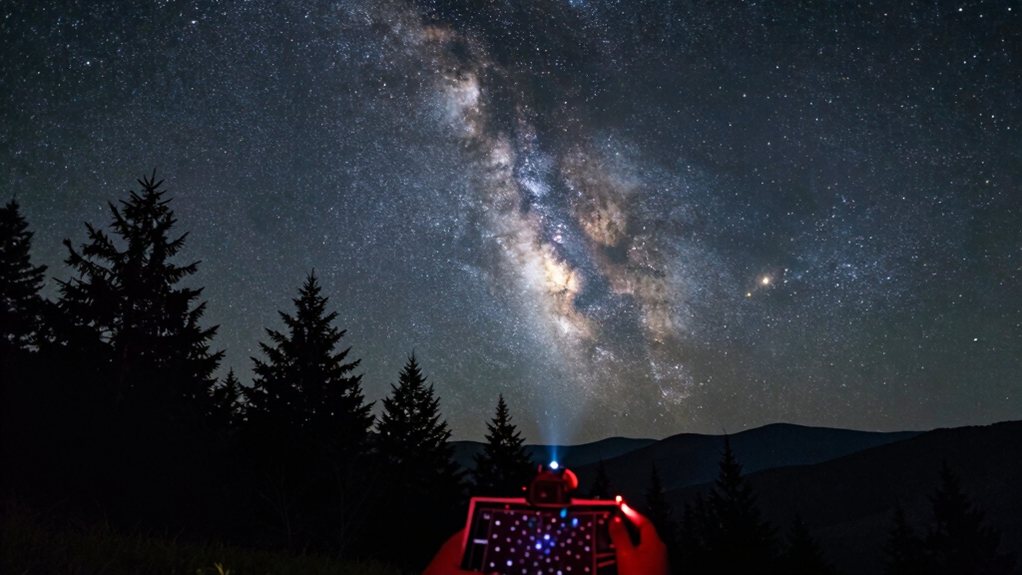
You’ll want to begin your stargazing voyage with three unmistakable patterns that serve as celestial landmarks throughout the year.
The Big Dipper’s curved handle and rectangular bowl offer an instant reference point for finding north.
Orion’s Belt provides a straight line of three brilliant stars visible even from suburban skies.
Together with the Summer Triangle’s bright vertices, these formations create a reliable foundation for navigating the night sky no matter your experience level. Additionally, using a projector like the BK-12 Starry Projector Light can enhance your stargazing experience by projecting colorful nebula options and making it easier to familiarize yourself with the night sky.
Big Dipper Guide
Wherever you find yourself tonight, there’s a good chance you can spot the Big Dipper without any equipment at all. This famous asterism isn’t an official constellation, but rather seven bright stars within Ursa Major that form an unmistakable ladle pattern. Its stars shine between magnitude 1.8 and 3.3, so you’ll catch them even under city lights.
Here’s how to make the Big Dipper your launchpad for exploration:
- Locate Polaris by extending a line through pointer stars Dubhe and Merak five times their separation.
- Trace the season’s arc: autumn brings it low, spring lifts it high, summer places it overhead.
- Follow the handle’s curve to Arcturus, then onward to Spica.
- Master star-hopping by returning to this reliable anchor point.
You’ll find that using a home planetarium projector can greatly enhance your stargazing experience. You’ll soon navigate the heavens with confidence.
Orion’s Belt Stars
How do you spot one of the night sky’s most reliable landmarks? Look for Orion’s Belt, three brilliant stars, Alnitak, Alnilam, and Mintaka, forming a tight diagonal line. You’ll find them centered in Orion’s rectangle, flanked by Betelgeuse and Rigel.
Once you’ve locked onto the Belt, extend its line downward to discover the Orion Nebula glowing faintly in Orion’s Sword. This stellar nursery rewards even modest binoculars.
Follow the same line upward, and it’ll steer you toward Sirius, the brightest star in Canis Major.
As winter deepens, notice how the Hyades and Aldebaran drift farther from the Belt, anchoring Orion in the southern sky. These relationships transform isolated stars into a navigable map. The knowledge gained from identifying constellations pairs nicely with the portable features of Dark-Skys Skyview, which allows for convenient stargazing anywhere.
Master the Belt, and you’ve unlocked a gateway to dozens of celestial neighbors.
Summer Triangle Trio
Orion’s Belt may anchor winter evenings, but summer skies offer their own dependable beacon. You’ll find the Summer Triangle rising prominently after sunset, formed by three brilliant first-magnitude stars that create an unmistakable pattern overhead.
Picture this scene:
- Vega gleams brightest in Lyra, positioned nearly straight up on clear nights
- Deneb marks Cygnus the Swan’s tail, topping the Northern Cross asterism
- Altair completes the trio, representing the eagle’s wing in Aquila
- The Milky Way’s luminous band arches behind them, offering cosmic depth
Use this trio as your gateway to fainter summer constellations. You’ll spot it gradually shifting westward through autumn, remaining visible until early winter fades it from view. Engaging in constellation storytelling can further enhance your family’s bonding time under the stars.
Use the Big Dipper to Find North Tonight

Ever found yourself disoriented under a star-filled sky, wondering which way leads home? Let the Big Dipper become your trusted north finder tonight. First, locate its distinctive bowl and handle, seven bright stars you can’t miss. Focus on Dubhe and Merak, the pointer stars marking the bowl’s outer edge. Draw an imaginary line through them, extending outward roughly five times their separation, and you’ll reach Polaris, the steadfast North Star.
Polaris anchors Ursa Minor, the Little Dipper, whose fainter stars form a smaller companion pattern. Together, these constellations create a reliable navigation system.
For extra confirmation, seek Cassiopeia’s distinctive M or W shape, positioned opposite the Big Dipper across Polaris. As Earth rotates, this entire arrangement wheels around the northern sky, but Polaris remains fixed, your constant guide through any season. While you’re exploring the night sky, consider enhancing your experience with a device like the DS-FX Home Planetarium, which provides realistic projections of over 3.1 million stars.
Find the North Star in the Little Dipper Constellation
Once you’ve followed the Big Dipper’s pointer stars toward Polaris, you’ll need to trace the faint outline of Ursa Minor to confirm you’ve found the right star. The Little Dipper’s distinctive pattern, four stars forming a modest bowl with three more trailing into a curved handle, helps distinguish Polaris at its very end. Don’t worry if you can’t spot every star at first; with practice, this subtle constellation becomes a reliable companion for your nighttime navigation. Additionally, using a starry night projector can enhance your understanding of constellations by simulating a realistic night sky right in your bedroom.
Locating Polaris Easily
Why wander through the night sky without a reliable anchor when Polaris offers exactly that? You’ll find this steady beacon by following a simple pointer line from the Big Dipper, that familiar asterism within Ursa Major.
Here’s your roadmap to locating Polaris:
- Face north and locate the Big Dipper’s bowl, two stars, Dubhe and Merak, form the outer edge.
- Draw an imaginary line upward through these pointer stars, extending it about five times their separation.
- Follow this trajectory until you reach Polaris, the brilliant anchor of Ursa Minor’s Little Dipper.
- Confirm your discovery by tracing the Little Dipper’s distinctive shape, four stars in the bowl, three in the handle, with Polaris marking the tail’s end.
Once found, you’ll notice Polaris remains nearly stationary while other stars wheel around it. This provides unwavering orientation for your celestial navigation.
Little Dipper Pattern
Where exactly does the North Star hide when you’re scanning the heavens? You’ll find Polaris tucked at the very end of the Little Dipper‘s tail, anchoring this delicate seven-star pattern.
The Little Dipper forms the recognizable shape of Ursa Minor, with four stars creating its bowl and handle and three tracing the curved handle. From the Northern Hemisphere, you’re in luck. This constellation stays circumpolar, circling Polaris without ever dipping below your horizon.
Don’t expect blazing brilliance, though. While Polaris shines at magnitude 2, its companions are notably fainter, making the full pattern challenging in light-polluted skies. You’ll need dark conditions and patience.
Here’s your strategy: locate the Big Dipper first, then extend an imaginary line through its pointer stars. Travel about five times that distance, and you’ve reached Polaris. Once you’ve found that anchor, trace outward to complete Ursa Minor’s subtle form.
Winter’s Best Constellations: Orion, Taurus, and Canis Major

How do you find your way around the winter sky when the cold air bites and the stars shine with unusual clarity? You start with Orion, the grand winter constellation everyone’s heard of. Look for its distinctive rectangle formed by Betelgeuse and Rigel, then spot the three diagonal belt stars bisecting it, these become your celestial compass.
Start with Orion’s distinctive rectangle and belt stars—your celestial compass through the winter sky’s crystalline clarity.
Trace a line from Orion’s belt stars upward, and you’ll discover Taurus with its V-shaped Hyades cluster and Aldebaran’s reddish-orange glow.
Continue that line further to find the sparkling Seven Sisters beyond.
Drop downward from the belt to locate Orion’s Sword, containing the magnificent Orion Nebula.
Follow Orion’s left shoulder eastward to spot Canis Major and Sirius, the brightest star in our sky, faithfully trailing the Great Hunter.
Spring and Summer Highlights: Leo, the Summer Triangle, and Cygnus
As winter’s brilliant stars begin their westward retreat, what new celestial treasures await your attention?
You’ll find spring constellations led by Leo the Lion, rising high in the south with its distinctive Sickle asterism forming the lion’s head and brilliant Regulus marking its heart. Use this striking pattern to navigate neighboring star groups.
When summer arrives, turn your gaze toward the Summer Triangle, formed by three brilliant first-magnitude stars: Vega, Deneb, and Altair. These anchors create an unmistakable guide across the warm evening sky.
Near this asterism, you’ll discover Cygnus the Swan, its Northern Cross shape outlined against the glowing Milky Way.
With binoculars, explore Deneb’s position at the cross’s top while tracing the galaxy’s star-rich path through the swan’s body.
Fall Constellations: Pegasus, Andromeda, and the Autumn Sky
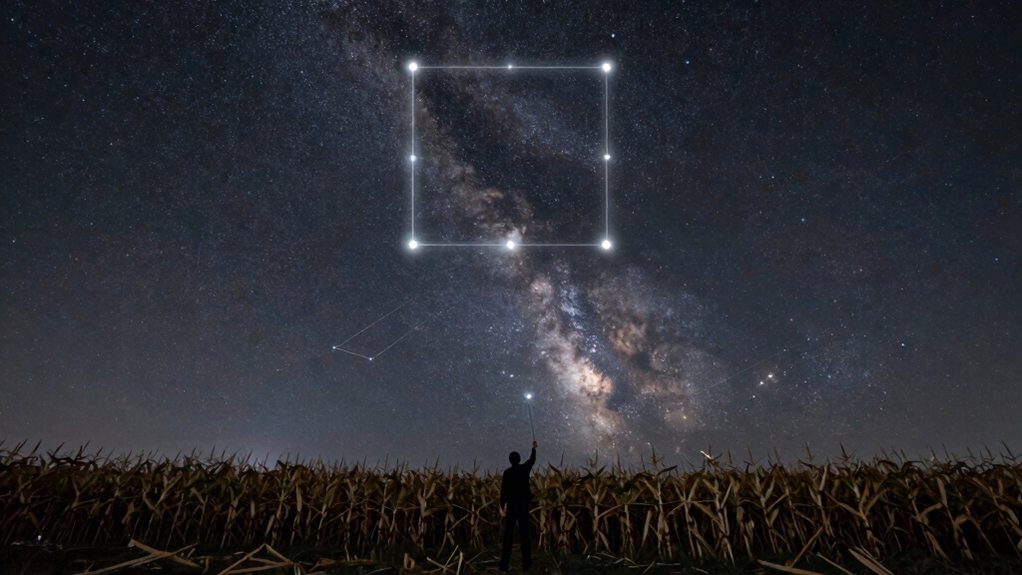
Why settle for summer’s fading glow when autumn’s sky offers its own magnificent landmarks? As the Milky Way fades, you’ll find Pegasus rising prominently, its Great Square anchoring the autumn sky like a celestial signpost.
To navigate these fall constellations, follow this guide:
- Locate the Great Square: Look high overhead for Pegasus’s signature four-star pattern, a massive asterism you can’t miss.
- Find Andromeda: Starting at Alpheratz, trace the curved chain of stars eastward from the Great Square’s corner.
- Spot the galaxy: Follow Andromeda’s star chain to glimpse M31, the most distant naked-eye object at 2.5 million light-years.
- Add Delphinus: Nearby, this small dolphin-shaped constellation completes your autumn tour.
These constellations transform cooling evenings into rewarding stargazing adventures.
Pick the Right Tool: Phone Apps vs. Paper Maps vs. Binoculars
Once you’ve learned to spot Pegasus and Andromeda drifting overhead, you’ll want reliable tools to deepen your explorations. Mobile apps like Stellarium and SkyView transform your smartphone into an interactive window on the night sky, using your location and sensors to identify constellations in real time. However, their bright screens can disrupt your night vision, so you’ll need to balance convenience with caution.
Paper maps and star charts offer a screen-free alternative. You can adjust a planisphere for any date and time, then hold it overhead to match patterns against the actual sky, perfect for practicing recognition while preserving your dark adaptation.
Finally, don’t overlook binoculars. A simple 7×50 or 10×50 pair extends your reach dramatically, revealing fainter stars that anchor familiar patterns and brighten the Milky Way’s star fields through summer and autumn evenings.
How Your Location Changes Every Constellation You See

Wherever you stand on Earth, you’re looking out at a unique slice of the cosmos. Your latitude determines which constellations you’ll ever see, since the sky location shifts dramatically based on where you plant your feet.
Your latitude is your window to the cosmos—every spot on Earth reveals a completely different celestial panorama.
Here’s how your position transforms your view:
- Northern vs. Southern Hemispheres: You’ll see completely different visible constellations: no Southern Cross from New York, no Big Dipper from Sydney.
- Circumpolar circles: Stars near the pole never dip below your horizon; your latitude fixes how many stay perpetually above.
- Equatorial advantage: Near 0° latitude, you can eventually spot all 88 constellations as seasons rotate them into view.
- Timing shifts: The same pattern rises four minutes earlier nightly, so your evening sky constantly evolves.
Understanding this helps you plan when to hunt specific patterns overhead.
Final Thoughts
You’ve got everything you need to start exploring the night sky tonight. Grab your phone or a simple star chart, step outside, and let the Big Dipper guide you toward your first discovery. Remember, constellations shift with seasons and locations, so each evening offers something new.
The universe isn’t going anywhere, take your time, keep looking up, and you’ll find your way among the stars.