You’ll want to start by checking your projector’s manual for disc compatibility, including mounting style and diameter requirements.
Match image density to your focus range. Higher density brings finer celestial details, but only if your projector can handle it. Consider your room’s lighting too, since dim spaces suit subtle star catalogs while brighter rooms need bolder multi-layer discs.
Track your collection to avoid duplicates, budget for quality official packs over cheap alternatives, and buy from verified sellers with solid return policies. There’s more to explore about maximizing your stargazing setup.
Check Your Projector’s Disc Compatibility
Where should you begin when expanding your star projector’s celestial library? Start by verifying disc compatibility with your specific model, such as the Orzorz Galaxy Lite. Check your manual to confirm whether your projector accepts multiple discs sequentially or requires manual swapping.
Examine the mounting method your device uses, whether it relies on center hub alignment or edge engagement, to avoid wobble and premature wear. Match disc diameter, thickness, and engraving precision with your current discs to preserve image fidelity.
Prioritize official manufacturer packs over third-party discs, as these guarantee proper focus, rotation speed, and control interface integration. Taking these precautions ensures your expansion packs deliver crisp, properly aligned projections without straining your projector’s drive mechanism. Additionally, consider choosing discs that feature nebulae such as the Helix Nebula, as this celestial object offers fascinating views of stellar evolution.

- 5K Ultra-HD Halloween Projector Discs – Include 6 vivid Halloween-themed projection discs…
- Tool-Free & Quick Replacement Design – Designed specifically for Galaxy Projector Pro…
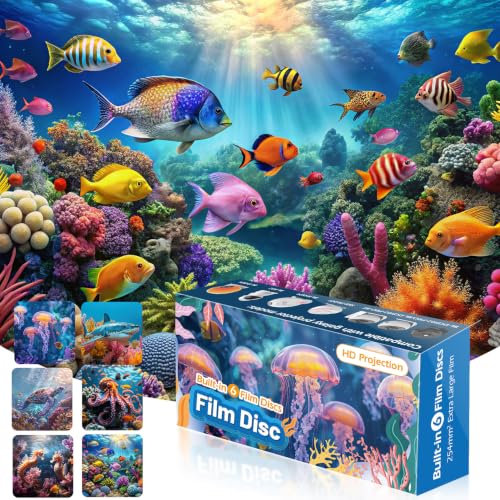
- Premium Galaxy Projector Pro Disc – Immerse Yourself in an Underwater Wonderland…
- Easy-to-Swap Film Discs for Instant Theme Changes – Designed for hassle-free replacement,…

- 【Versatile Galaxy Projector Pro Disc – 6 Captivating Wildlife Scenes】This interchangeable disc…
- 【Breathtaking 4K Ultra HD Projector Slides for Razor‑Sharp Detail】Every feather, fur strand,…
Compare Image Density Across Star Projector Discs
Several factors distinguish one expansion disc from another, but image density deserves your closest attention when you’re chasing that perfect night-sky illusion. Higher engraving density on expansion discs delivers more star points and finer celestial details, transforming your star projector from a simple light show into an immersive cosmos.
Image density makes the difference between a simple light show and an immersive cosmos.
You’ll notice high-density discs create richer depth and smoother transition between constellations, though they demand precise disc calibration and projectors with strong alignment capabilities. Cheaper options use simpler engravings, giving you brighter but less nuanced fields.
If you’re after scientific accuracy, prioritize discs packed with extensive star catalogs; these sacrifice easy manufacturing for superior fidelity. The Pococo Galaxy Lite, for example, is designed to accommodate various multi-disc functionality while maintaining projection quality.
Before purchasing, verify your projector can handle the demands. Check its focus range to ensure high-density discs project crisply without distortion, or you’ll waste money on detail you can’t display.

- Upgraded 6‑Pack Ocean Themed Discs Set: Includes 6 premium 5K ultra‑HD ocean…
- Rich Underwater Scenes for All‑Age Enjoyment: Features diverse marine views including octopus,…

- Exclusive Fit for BL‑DQY02 Only, Excludes BL‑DQY02‑PRO:Kindly verify your device model prior…
- Upgraded 6 Galaxy Discs Set:Equipped with 6 exclusive 4K ultra HD galaxy…

- 🌊 4K Ultra-HD Ocean Projector Discs – Includes 6 vivid ocean-themed projection…
- ⚙️ Tool-Free & Quick Replacement Design – Designed specifically for Galaxy Projector…
Avoid Duplicate Scenes When Expanding Your Collection
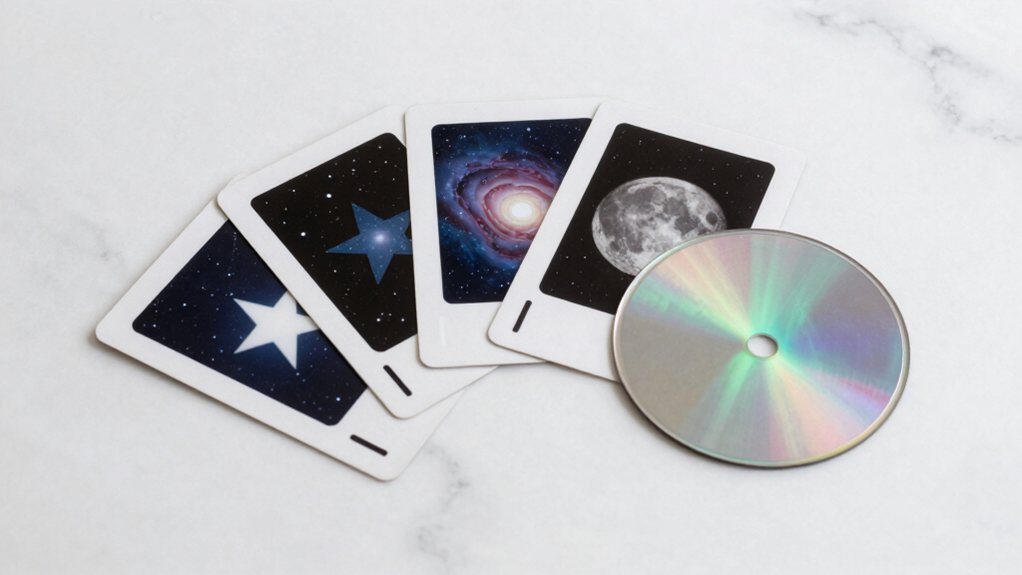
Once you’ve narrowed your choices by image density, you’ll want to make sure each new disc actually expands your night-sky repertoire rather than echoing what you already own. Start by building a content catalog that tracks each disc’s imagery, so you can practice effective scene rotation and avoid duplicates during your sessions.
Implement disc labeling with clear notes about themes and angles, then use theme sequencing to rotate through expansion discs strategically, perhaps seasonal visuals in winter, educational constellations in spring. Additionally, consider the projector design and placement to ensure optimal performance without overheating during prolonged use.
Before purchasing unique expansion packs, run a quick compatibility check against your inventory to ensure genuine overlap prevention.
These star projector accessories should diversify your collection, not duplicate it. Thoughtful planning transforms random purchases into a cohesive, ever-changing celestial experience.
Calculate Cost Per Disc and Budget Smart
how many scenes do you actually need? Buy the minimum boxes covering your anticipated rotation, then expand later. This budget optimization prevents overspending while keeping your nights brilliantly varied. Smart math, smarter skies. Consider options that offer customization possibilities, as they can enhance your stargazing experience.
Pick Disc Themes That Work in Your Lighting
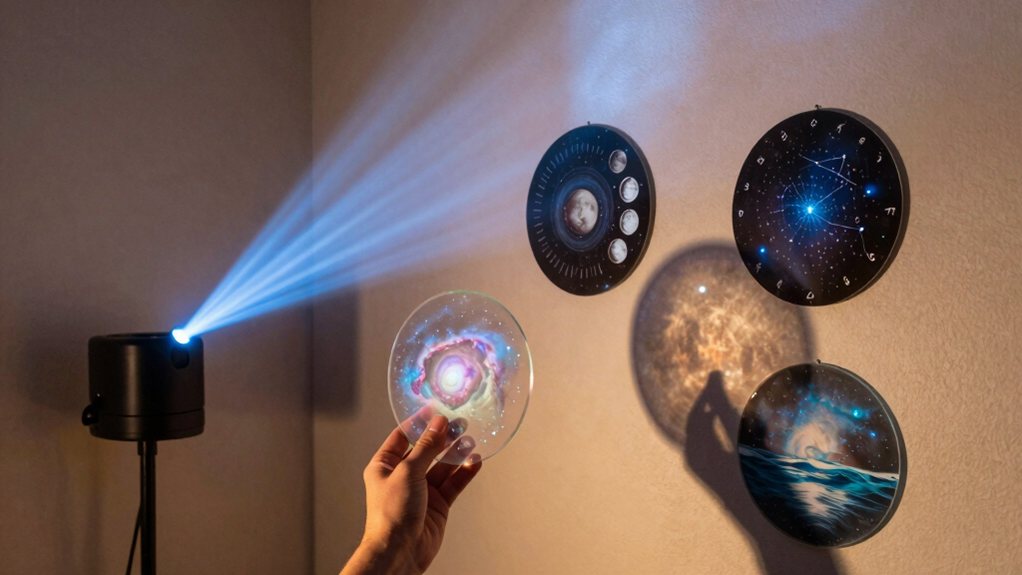
Why settle for a star field that clashes with your room’s glow when you can curate discs that thrive in your actual lighting conditions? You need expansion discs that complement, not compete with, your ambient setup.
In dim environments, you’ll want Celestial Design or Annual Motion discs for scientifically accurate displays that maintain crisp detail. These work beautifully when you’ve completed compatibility calibration to ensure peak performance.
Brighter rooms demand stronger solutions. Multi-Layer discs and Full-Sky discs deliver depth projection that cuts through moderate light, preserving that immersive feel you crave. Their layered construction creates visual pop even when surrounding lamps stay on.
Consider your typical usage: soft mood enhancement during evening wind-downs, or vibrant displays for social gatherings? Match your disc selection to these lighting conditions, and you’ll maximize every projection session without compromise. Additionally, remember that some projectors, like Dark-Skys Skyview, offer a compact design and high projection quality to enhance your experience.
Find Reliable Sellers and Verify Authentic Discs
The right expansion disc won’t do you any good if it arrives warped, incompatible, or counterfeit. You need reliable sellers who explicitly list expansion discs compatible with your exact projector model, ensuring proper fit and image fidelity.
Start by checking brand listings and verified retailer badges to confirm you’re buying authentic discs. Match product codes to official expansion packs, and examine disc contents carefully. Pococo-compatible packs run about $50 per box with four options available.
Don’t skip seller Q&A sections; you’ll want confirmation on rotation compatibility and seasonal designs. Finally, prioritize sellers with solid return policies. This protects you against warping, coating peeling, or compatibility issues that could surface months after purchase. Additionally, consider models with various projection patterns, as they may offer more diverse imagery for your star projector.
- Upgraded 6‑Pack Ocean Themed Discs Set: Includes 6 premium 5K ultra‑HD ocean…
- Rich Underwater Scenes for All‑Age Enjoyment: Features diverse marine views including octopus,…
- 5K Ultra-HD Halloween Projector Discs – Include 6 vivid Halloween-themed projection discs…
- Tool-Free & Quick Replacement Design – Designed specifically for Galaxy Projector Pro…
- Exclusive Fit for BL‑DQY02 Only, Excludes BL‑DQY02‑PRO:Kindly verify your device model prior…
- Upgraded 6 Galaxy Discs Set:Equipped with 6 exclusive 4K ultra HD galaxy…
Final Thoughts
You’ve got everything you need to build an impressive disc collection without wasting money or space.
Start small, prioritize quality over quantity, and let your personal taste guide your choices.
The right discs will transform your room into something truly special, night after night.
Happy stargazing!